Structural Drying in Duvall
Duvall's mild, wet climate keeps building materials damp for long stretches. The crew uses LGR dehumidifiers, air movers and moisture readings to dry framing and subfloors until they match a dry reference.
(888) 509-1696Start a measured dry-out- LGR dehumidifiers
- Air movers
- Psychrometric logs
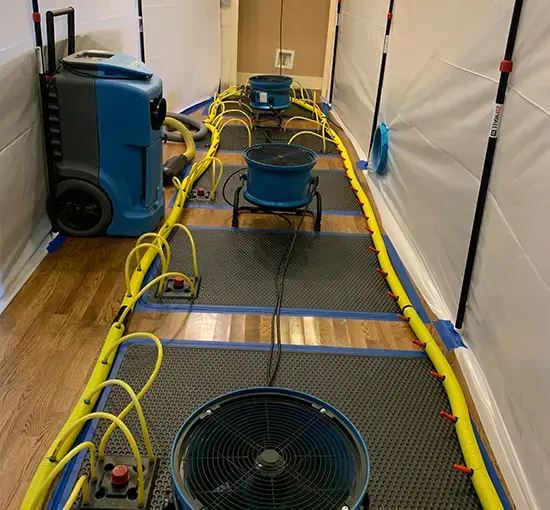
First steps for structural drying and dehumidification in Duvall
- 1
Keep it closed
Leave doors shut so dry air stays put.
- 2
Leave the gear
Do not move or switch off the equipment.
- 3
Note the changes
Report new stains or odors.
- 4
Plan for visits
Readings are taken every day.
How the crew handles structural drying and dehumidification in Duvall
Removing the water is only half the job. Wood, drywall and concrete hold moisture long after the surface looks dry, and structural drying is the measured stage that pulls it out and proves it is gone.
Water still moving in Duvall?
(888) 509-1696Send a drying crewWhat does structural drying and dehumidification cost in Duvall, WA?
Structural drying runs $1,500 to $28,000, with one or two rooms at the low end and a Class 4 or whole-house job needing desiccant drying at the high end of the range.
Ranges are typical, not a quote: the water category, square footage, material class and how fast drying started move the number most. Run the water damage cost calculator for a closer range.
One or two rooms
$1,500 to $4,500
- Air movers with LGR units
- Readings every day
- Moisture log kept
Several rooms or a level
$4,500 to $11,000
- Wall cavities dried
- Subfloor drying
- Added equipment
Class 4 or whole house
$11,000 to $28,000
- Desiccant units
- Hardwood drying mats
- Longer monitoring
How structural drying and dehumidification is handled in Duvall, step by step
Measure
Map wet materials with meters and thermal imaging.
Set equipment
Place dehumidifiers and air movers by the readings.
Monitor
Take readings each day and adjust the gear.
Verify
Match framing to the dry reference, then remove equipment.
Why wet seasons slow drying
Duvall has a marine west coast climate with adequate rain year-round, and the Snoqualmie Valley floods from late fall to early spring. Humid outdoor air limits what open windows can do, so closed-system drying with dehumidifiers does the work.
Equipment is placed from the readings, not by a fixed formula, and it is adjusted each day.
- LGR dehumidifiers for humid air
- Air movers aimed at wet surfaces
- Moisture meters in framing and subfloor
- Thermo-hygrometers for the air
Wall cavities, subfloors and hardwood
Wall cavities are dried with injection or by opening the bottom of the wall, and subfloors are dried from above and below. Hardwood may need drying mats that pull moisture up through the boards.
Where the room is sealed, plastic containment holds the dry air in, after the first stage described in water extraction.
Proving the structure is dry
Daily readings are logged in a psychrometric record, and equipment stays until the framing and subfloor match the dry reference taken from an unaffected room. Crawl space water damage follows the same measured approach under the floor.
Trade fact: Hardwood can cup weeks after a leak if it was dried too fast or not far enough, so readings set the pace.
Structural drying and dehumidification across Duvall and nearby towns
Drying equipment is placed across Duvall, from the Main Street core to the hillside neighborhoods of Big Rock, The Ridge at Big Rock and Taylor's Ridge. The Duvall hub lists every service.
The same service nearby: structural drying and dehumidification in Sammamish, Redmond, Kirkland.
Related water damage services in Duvall
Why does a dry-looking wall still need drying?
Moisture can sit inside the cavity and framing while the surface looks dry, so meters check what the eye cannot.
What does an LGR dehumidifier do?
It pulls moisture from the air at low humidity levels, which keeps drying going when the room is already fairly dry.
How long does structural drying take?
Usually a few days, longer for hardwood or a large loss, with daily readings deciding when the gear can leave.
Is the equipment loud?
Air movers and dehumidifiers make steady noise, and the placement is adjusted to keep rooms as usable as possible.
What is a dry reference reading?
It is a moisture reading from an unaffected area of the same material, and it sets the target for the wet area.
Can wet hardwood be saved?
Often, with drying mats and slow, monitored drying, but severely cupped boards may still need replacement.
Dry the structure to a number, not a guess
The crew sets dehumidifiers and air movers, logs readings each day and removes equipment only when the framing is dry.
Sammamish, WA · King County · open 24/7