Structural Drying and Dehumidification in Sammamish, WA
Surfaces dry in a day; framing, subfloor and wall cavities do not. The drying team sizes air movers and dehumidifiers to the loss and logs readings until the structure matches a dry reference.
(888) 509-1696Get the structural drying started- LGR and desiccant units
- Psychrometric logs
- Dry reference goal
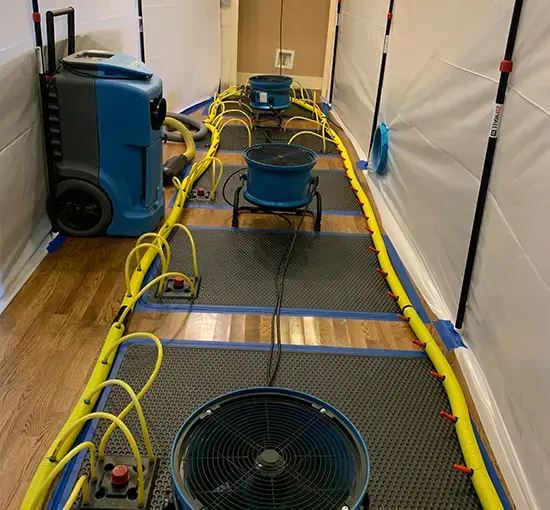
First steps for structural drying and dehumidification in Sammamish
- 1
Remove standing water
Extraction comes before drying.
- 2
Keep the heat on
A warm house dries faster.
- 3
Leave equipment running
Turning it off resets progress.
- 4
Keep doors as set
The crew sets them for airflow.
How the crew handles structural drying and dehumidification in Sammamish
Structural drying is the part of a water job that decides whether the house stays sound. Water that soaked into studs, plates, subfloor and hardwood has to come out, and the drying team proves it with numbers.
Water still moving in Sammamish?
(888) 509-1696Get readings startedWhat does structural drying and dehumidification cost in Sammamish, WA?
In Sammamish, WA, structural drying typically runs $1,500 to $28,000, depending on the class of loss, how many rooms and levels are wet and whether hardwood, concrete or wall cavities need specialty drying.
Ranges are typical, not a quote: the water category, square footage, material class and how fast drying started move the number most. Run the Sammamish water damage cost calculator for a closer range.
One or two rooms
$1,500 to $4,500
- Air movers and LGR
- Daily readings
- Psychrometric log
Several rooms or a level
$4,500 to $11,000
- Wall cavity drying
- Subfloor drying
- More equipment
Class 4 or whole house
$11,000 to $28,000
- Desiccant drying
- Hardwood mats
- Extended monitoring
How structural drying and dehumidification is handled in Sammamish, step by step
Classify
Category and class set the plan.
Set equipment
Air movers and dehumidifiers sized to the load.
Log daily
Temperature, humidity and moisture recorded.
Verify dry
Readings within 2 to 4 points of the dry reference.
How the drying plan is set
The class of loss, Class 1 to 4, sets how much equipment each room needs. Air movers are placed to sweep wet surfaces and dehumidifiers are sized to pull the moisture out of the air.
In the wet season, outdoor air on the plateau stays cool and damp, so opening windows does little. LGR dehumidifiers do most of the work, and desiccant units take over for dense Class 4 materials.
- Air movers set to the room's evaporation load
- LGR dehumidifiers for most losses
- Desiccants and drying mats for hardwood and concrete
- Wall cavity drying through small openings
Psychrometric logs
Each day the drying team records temperature, relative humidity and moisture content in the affected rooms and a dry reference area. The log shows the house drying and goes into the claim file. Drying fast also keeps materials out of the 24 to 48 hour window the EPA gives for mold growth.
When the equipment comes out
Materials must read within 2 to 4 points of a dry reference material in the same home. Only then does the drying team pull the equipment. Energy Saver explains how indoor humidity affects a home.
Trade fact: Dehumidifiers remove water from the air; air movers move water from materials into the air. A drying plan needs both, in balance.
Structural drying and dehumidification across Sammamish and the plateau
The Sammamish restoration crew covers ZIP 98074 and 98075, from Sahalee and Inglewood in the north through Sammamish Highlands, Pine Lake and Beaver Lake to Klahanie, Trossachs and the homes along East Lake Sammamish.
Nearby coverage reaches Redmond, Issaquah, Bellevue, Kirkland, Duvall, Fall City and Carnation.
Related water damage services in Sammamish
What does 2 to 4 points of dry mean?
The wet material's moisture reading must come within 2 to 4 points of the same material in an unaffected area of the house.
Why is the equipment so loud?
Air movers move a lot of air across wet surfaces. That airflow is what pulls the water out of materials.
Can I turn the dehumidifier off at night?
Please do not. Turning equipment off lets humidity climb back up and slows the dry-out.
What is a desiccant dehumidifier?
A unit that pulls moisture out of air with a drying material instead of cold coils. It works well on dense, slow-drying materials.
How long does structural drying take?
Usually three to ten days, depending on the class of loss and materials.
Why keep a psychrometric log?
It shows the house drying day by day and gives the adjuster proof that the job reached dry.
Wet framing in Sammamish? Start the dry-out now.
Structure that stays wet keeps swelling and smelling. The drying team sets equipment and logs readings until it is dry.
Sammamish, WA · King County · open 24/7