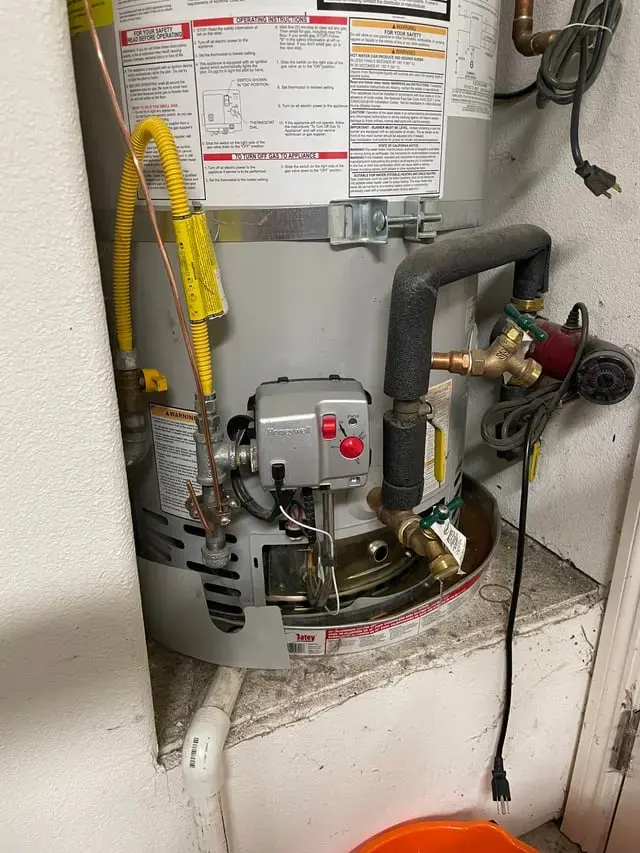
A tank that gives out can soak a closet, a garage floor and the wall bottoms next to it before anyone notices. In Bellevue the replacement also comes with paperwork, because the city has its own permit rules and King County Public Health has advice on seismic bracing. This post covers the shutoff steps, the permit types, the straps and how the cleanup is done.
Key takeaways
- Close the cold water supply to the tank and turn off its power or gas first, then deal with the water on the floor.
- In Bellevue a plumbing permit is needed to replace an electric water heater, and a gas water heater needs a mechanical permit.
- King County Public Health says a water heater needs seismic bracing of 2 straps of 20 gauge sheet metal.
- The permit belongs to the replacement, not to the cleanup, so the two jobs are planned together.
- Wall bottoms and floors around the tank are extracted and dried with meters before they are closed up.
When a tank lets go
Water heaters usually fail in a way that is easy to miss until the floor is wet. A seam weeps, a fitting loosens or a valve starts to drip, and the water finds the lowest point.
In a closet or utility room, that point is often the base of the wall and the floor under it. In a garage, it is the slab and anything stored on it.
- A puddle at the base of the tank, or a stain on the floor beside it
- Rust marks on the tank or at the pipe connections
- A relief valve that drips or a tank that makes popping noises
- A damp smell or soft wall board near the heater
What to do right away
Start with the supply. Close the cold water valve on top of the heater to stop new water from entering the tank.
Then turn off the heat source. An electric heater is switched off at the breaker, and a gas heater is set to off at the control or the gas shutoff.
Once the source is under control, the water on the floor is the next job. Water extraction in Bellevue removes it before it wicks into walls and flooring.
- Close the cold supply valve above the tank.
- Switch off the breaker or the gas control, depending on the heater.
- Stay out of standing water near an electric heater or wiring.
- Photograph the tank, the floor and any wet materials before cleanup.
Where the tank sits changes the damage
A tank in a garage spreads water across the slab, where it can reach stored boxes and the bottom of the wall. A tank in a closet sends water into the framing and, in a two story house, toward the room below.
A tank in a utility room or near a finished room is the hardest case, because water can slip under flooring and out of sight.
- Garage: water spreads across the slab and soaks anything stored low.
- Closet: water runs into the wall bottom plate and the adjacent rooms.
- Utility room: water can travel under flooring toward a hallway or kitchen.
- Upper floor: water can reach the ceiling below, which adds a second repair.
Bellevue's permit rules for a replacement
A City of Bellevue plumbing permit is needed to replace an electric water heater, while replacing a gas water heater needs a mechanical permit. Applications go through MyBuildingPermit.com.
A plumbing permit is also needed to alter piping inside a wall, ceiling or beneath a floor, but not to replace a sink, toilet or faucet with a similar fixture in the same place.
Bellevue plumbing permits that do not require a plan check can be issued quickly, so the paperwork rarely has to hold up a replacement.
Electric heaters
An electric replacement needs a plumbing permit before the new tank is installed.
Gas heaters
A gas replacement needs a mechanical permit, which is a different permit type and a different application.
Keeping the cleanup and the replacement in step
The permit is tied to the new tank, not to the cleanup, so the two jobs have to be planned together. Drying can start while the replacement is arranged, and the crew's readings help decide when walls can be closed.
Ask the installer whether the permit has been applied for before the old tank comes out. That avoids a gap where the home has no hot water and no clear date for the new heater.
- Extraction and drying can start before the new tank is installed.
- The installer handles the plumbing or mechanical permit.
- Wall and floor repairs wait until drying readings are back to normal.
Seismic straps and why they matter
King County Public Health says a water heater needs seismic bracing of 2 straps of 20 gauge sheet metal. The straps keep a tank upright when the ground shakes, which protects the supply connections.
A tank that tips can break its pipes and its gas connection. That adds a second water problem on top of whatever caused the first one.
- Two straps hold the tank in place.
- The straps are made of 20 gauge sheet metal.
- A replacement is a good time to check that bracing is in place.
How the cleanup works
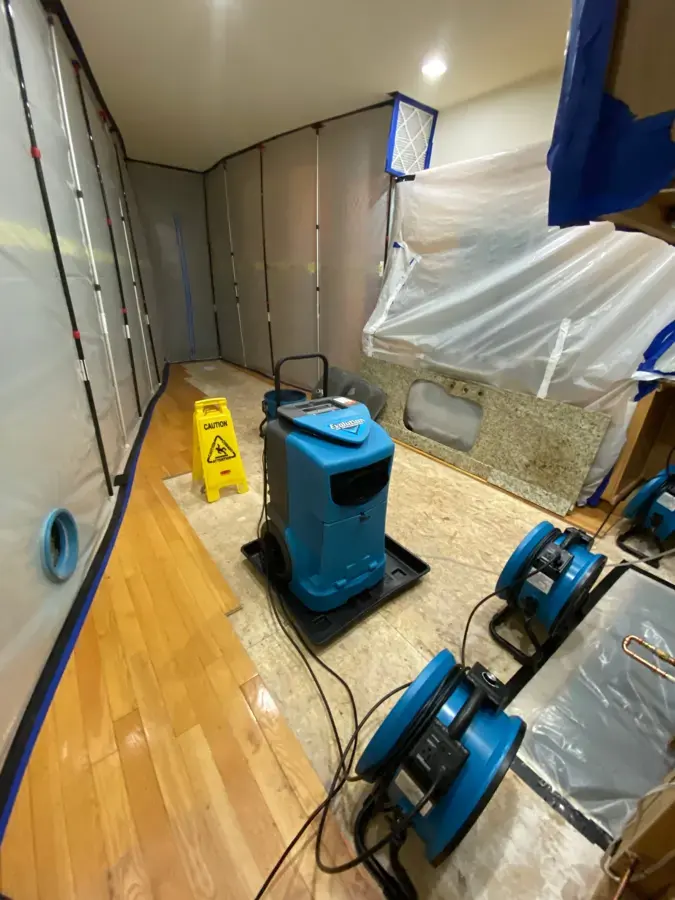
Extraction comes first, and then the crew looks at what the water reached. A water heater leak cleanup in Bellevue checks the wall bottoms, the baseboards and the floor around the tank.
Moisture meters show how far the water traveled. Wet insulation and drywall at the base of a wall are removed, and the framing and subfloor are dried with air movers and dehumidifiers.
If the leak ran for a while, the readings help decide whether flooring has to come up so the subfloor can dry.
- Standing water extracted from the floor
- Wet baseboards and the lower part of the wall board removed
- Insulation at the base of the wall bagged and replaced
- Framing and subfloor dried until readings match a dry reference
Slow leaks and Bellevue's smart meters
Bellevue began installing advanced metering for all water customers in 2018, and the meters can report customer side leaks and backflow incidents. A tank that weeps all day can show up as a steady flow on the meter.
That is useful because a slow leak does not look dramatic. The floor stays damp, the wall bottom softens and the damage grows quietly.
For homes with a heater in a closet, the main water heater leak page explains how the work is organized.
Questions
Does a Bellevue homeowner need a permit to replace a water heater?
Yes. Replacing an electric water heater needs a plumbing permit, and replacing a gas water heater needs a mechanical permit.
Where are Bellevue water heater permits requested?
Applications go through MyBuildingPermit.com.
What do seismic straps do?
They keep the tank upright in an earthquake so the water and gas connections are not torn loose. King County Public Health calls for 2 straps of 20 gauge sheet metal.
Does the cleanup need its own permit?
The permit rules in the city facts are about replacing the heater or altering piping. Drying and extraction are handled as cleanup, while the replacement follows the permit steps.
Can a leaking tank be repaired?
A tank that leaks from its body is usually replaced. The cleanup deals with the water the leak left behind.
Where else can a Bellevue homeowner look for help?
The Bellevue page lists the water services available in the city.