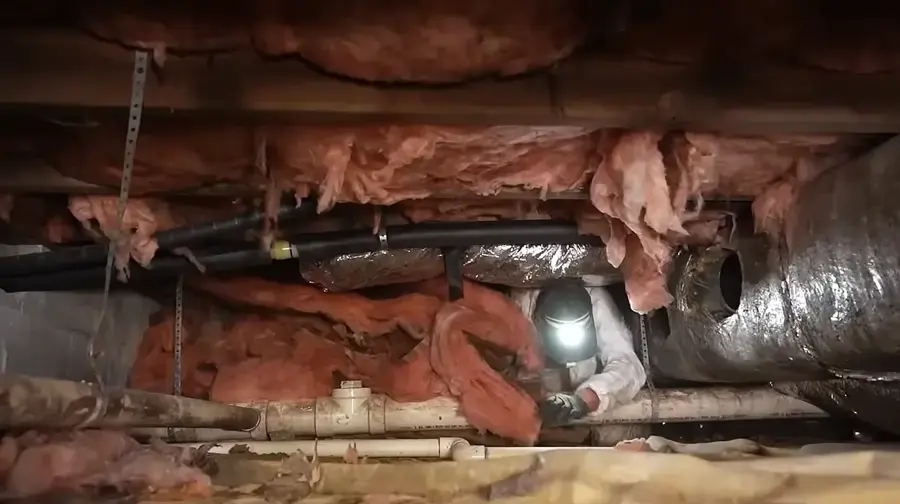
Atmospheric river storms can soak the Sammamish Plateau for days, and the water does not always stay outside. Much of the plateau sits on dense glacial till that locals call hardpan, so rain perches on top of it and runs sideways toward foundations and into vented crawl spaces. This post explains how to tell standing water from damp air, what to shut off, and what a crew removes first when a Sammamish crawl space takes on water.
Key takeaways
- Hardpan drains slowly, so days of rain can push water sideways into a crawl space even when the yard looks fine.
- Standing water, sagging insulation and a bunched vapor barrier are real water problems, while a musty smell alone may only be damp air.
- Stay out of a wet crawl space, and switch off power to the area only if the panel is dry and easy to reach.
- Wet insulation and a soaked vapor barrier usually come out first, then joists and subfloor are dried with meters.
- Water that arrived with runoff is treated as Category 3, so it is not a do it yourself job.
Why rain ends up under Sammamish houses
Most of the plateau was built out from the 1980s through the 2000s as suburban subdivisions. Large two story wood frame homes are common, and many of them sit over a vented crawl space.
Under the topsoil, dense glacial till drains slowly. Rain soaks in, meets the hardpan and slides sideways along it, often toward a foundation wall.
The rain season runs from October through April, and an atmospheric river can keep the ground full for days. By the third wet day the soil has nowhere to send water except toward the lowest space nearby.
- Perched water: rain that stops at the hardpan and travels sideways toward footings and vents.
- Saturated ground: days of steady rain leave the soil full, so new rain runs along the surface.
- Roof and gutter overflow: water that lands beside the foundation adds to the load.
- Vented openings: foundation vents let splashed water and wet air into the space.
Why the yard can look fine while the crawl space fills
Perched water moves under the surface, so the lawn and the driveway can look normal while water collects under the floor. Nothing on top of the ground warns the owner.
That is why a check from the access hatch after a long storm is worth the quick look it takes. It is the only way to see what the soil has been doing.
Standing water or damp air: how to tell
A crawl space can smell wet without holding any water, so the first job is sorting out what is actually there.
A flashlight from the access hatch tells most of the story. Look from the opening and do not crawl into a wet space.
Signs of standing water
Standing water shows as a shine on the soil or a visible puddle, often at the low corner away from the hatch.
Ripples that move when gusts hit the vents point to a source that is still active.
- A film or puddle on the ground under the joists
- Insulation batts that sag, darken or lie against the soil
- A vapor barrier that floats, bunches or is pushed to one side
- Mud marks on the foundation wall that were not there last week
Signs of damp air alone
Damp air leaves condensation on cold pipes, a musty smell and slightly dark wood, but no visible puddle.
That can still matter in a wet season, because wood that stays damp for weeks needs readings from a meter, not a guess.
- Beads of moisture on supply pipes
- A musty smell that rises through floor vents
- Wood that feels cool and damp but shows no stain edge
What to shut off and what to leave alone
If water is standing near the hatch, stay out of the space. Wiring, ducts and sometimes a water heater share a crawl space, and wet ground carries electricity as well as a wet floor does.
Turn off power to the area at the panel only if the panel is dry and easy to reach. If there is any doubt, leave it alone and ask for help.
Close the home's main water valve if a supply pipe could be involved, because a split pipe adds clean water to a space already holding runoff. Once the area is safe, water extraction in Sammamish starts with pumping out what is standing.
- Stay out: do not step into standing water near wiring or equipment.
- No improvised pumping: a household vacuum or a pump on a wet extension cord is a shock risk.
- Photograph first: take pictures of the water level and wet materials from the hatch before anything is moved.
- Leave the batts: wet insulation is heavy and can hide wiring, so pulling it down by hand is not wise.
What the crew removes first
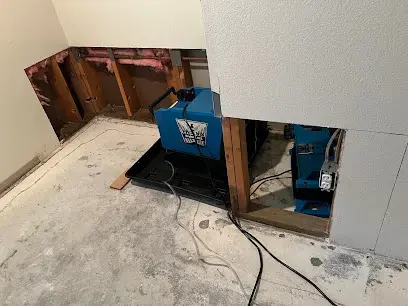
Water goes first. A pump or extractor lowers the level so the soil and the lowest joists can be seen.
Then wet insulation and the vapor barrier come out. Soaked batts do not dry in place, and a barrier that has sat under water can trap moisture against the soil.
Runoff that crossed yards and driveways is treated as Category 3 water, which means it is contaminated. The crew wears protective gear and bags wet material for disposal.
- Standing water pumped out
- Wet insulation batts cut out and bagged
- Vapor barrier lifted, cleaned or replaced
- Silt, mud and debris cleared from low corners
How joists and subfloor get dried
Once the space is clear, moisture meters check the joists, the underside of the subfloor and the sill plates. Readings are compared with a dry reference so the crew knows when the wood is back to normal.
Air movers and dehumidifiers then run until readings match. A crawl space is cramped, so hoses and ducts are fed in from the hatch.
Careful structural drying matters here because framing that stays damp through a long wet season invites trouble later.
- Joists: readings taken at several points along each one
- Subfloor: checked from below before any flooring above is opened
- Ducts and wiring: confirmed dry before power returns to the space
Getting ahead of the next atmospheric river
The October to April season means the same crawl space can take water more than once. A few habits make the next soaking easier to catch.
Gutters and downspouts are the cheapest part of the plan, because roof water that lands beside the foundation joins the water moving through the till.
- Downspouts: confirm they carry roof water well away from the foundation.
- First storm check: look into the crawl space after the first heavy storm of the season, not after the third.
- Clear access: keep the hatch and vents uncluttered so the opening can be inspected.
- Dry photos: take pictures when conditions are dry so later changes are easy to see.
Questions
Is water in a Sammamish crawl space always a flood?
No. It can come from rain that perches on the hardpan, a roof or gutter overflow, or a split supply pipe. The source decides whether it is treated as clean water or as Category 3.
Can a crawl space be dried without removing insulation?
Insulation that has sat in water usually does not dry in place and is removed. Batts that only felt damp may be checked with a meter first.
Why does water seem to arrive after the rain stops?
Perched water keeps moving sideways through saturated soil for a while after rain eases, so a space that looked fine can fill later.
What if the crawl space looks empty but the floor above feels cold and damp?
That can point to wet insulation or damp joists. Meter readings, not touch alone, show whether the framing needs drying.
Where can Sammamish homeowners see which neighborhoods are covered?
The Sammamish service area page lists the neighborhoods and nearby towns, and the water extraction page explains how standing water is removed first.